
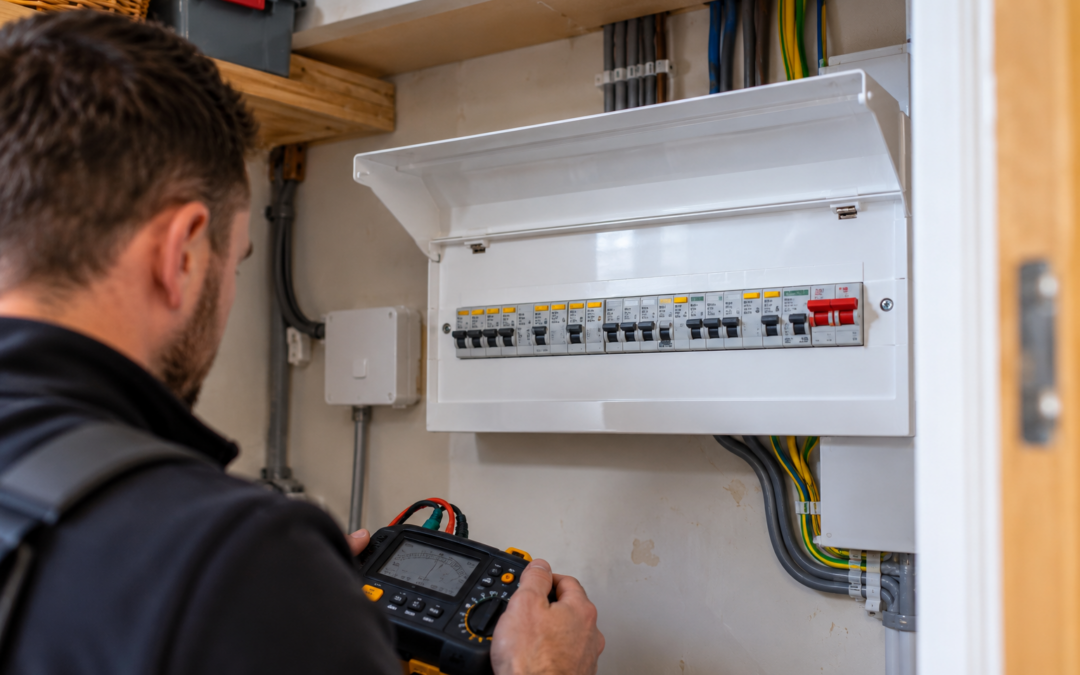
The Short Answer – What does a consumer unit upgrade cost in Kent?
A typical consumer unit (fuse box) upgrade in Kent costs between about £500 and £1,000 in 2026 for an average three bedroom home. A straightforward swap with a split-load board sits at the lower end. A full RCBO board with surge protection, or a job that needs earthing and bonding corrections, sits at the upper end. Larger boards and relocated units can cost more. The price should always include the new unit, labour, full circuit testing and an Electrical Installation Certificate.
Published UK guides put South East pricing at roughly £700 to £950 for a standard 10 circuit board, and up to £1,200 for larger or relocated boards. Local pricing varies with access, the age of the wiring and what testing uncovers.
What is a consumer unit?
A consumer unit, often still called a fuse box or fuse board, is the main control point for electricity in your home. It splits the incoming supply into separate circuits and contains the protective devices (fuses, MCBs, RCDs or RCBOs) that cut power when something goes wrong. Modern units protect against electric shock and reduce fire risk. Older units often do not.
Consumer unit upgrade cost by type of board
| Type of upgrade | Typical South East price (2026) | Best for |
|---|---|---|
| Like-for-like main switch board (fewer circuits) | £650 to £850 | Small flats and very simple installations |
| Dual RCD / split-load board (up to 10 circuits) | £700 to £950 | Most standard homes |
| High integrity RCBO board with surge protection | £850 to £1,100 | Homes with solar, EV chargers or sensitive electronics |
| Larger 12 to 16 way board or relocated unit | £950 to £1,200 | Extended or renovated homes |
Source for ranges: Fantastic Services 2026 UK cost guide. Always get a written quote after a site visit.
What affects the price of a fuse box replacement?
- Number of circuits. More ways means a bigger board and more labour.
- RCBOs versus RCDs. RCBOs protect each circuit individually, so one fault does not trip half the house. They cost more but are far more convenient.
- Remedial work. Poor earthing, missing bonding or damaged cable found during testing must be corrected before the new board is energised.
- Location and access. A board in a cupboard under the stairs is quicker than one behind plasterboard or in a tight meter box.
- Extras. Surge protection, AFDDs and extra circuits for an EV charger or battery all add cost.
What we see in Kent homes
In our 18+ years working on properties across Kent, from Victorian terraces in Rochester to 1960s semis around Maidstone and period homes near Sevenoaks, the same issues come up again and again when we open a board:
- Rewireable ceramic fuses or early MCB boards with no RCD protection at all.
- Plastic consumer units in under-stairs cupboards, which current regulations no longer favour.
- Extensions and loft conversions wired into a board that was already full, sometimes with double-tapped breakers.
- Missing or undersized earth and gas or water bonding.
- Old rubber or cloth insulated cable on lighting circuits that a new board cannot make safe on its own.
That last point matters. A new consumer unit protects the circuits connected to it, but it does not fix tired wiring. If testing shows widespread deterioration, we will tell you plainly when a rewire makes more sense than patching. See our house rewiring services for how we make that call.
5 signs your fuse board may need replacing
- It has ceramic rewireable fuses or no RCD.
- Circuits trip repeatedly, or an RCD will not reset.
- You can see scorching, a burning smell or a buzzing noise at the board.
- You are adding solar panels, a battery or an EV charger and the board is full.
- Your EICR flagged the board as unsatisfactory (a C2 or C3 observation, or FI for further investigation).
Do I need a new consumer unit after an EICR?
Often, yes. An EICR (Electrical Installation Condition Report) grades problems with codes. C1 means danger present and needs immediate action. C2 means potentially dangerous and urgent remedial work is required. C3 means improvement recommended. FI means further investigation is needed. A board with no RCD protection on socket circuits commonly receives a C2 or C3, depending on the circuit, and a C2 gives a report an unsatisfactory result. Landlords in England must act on C1 and C2 items within 28 days under the Electrical Safety Standards in the Private Rented Sector Regulations.
How a consumer unit upgrade works: our process
- Survey and quote. We check the existing board, earthing, bonding and circuit count, then give a fixed written price.
- Preparation. Power is off for roughly 4 to 6 hours, so we suggest charging devices, saving work and clearing access to the board.
- Installation and testing. We fit the new unit, reconnect each circuit and test for insulation resistance, continuity and RCD operation.
- Certification. You receive an Electrical Installation Certificate, and we notify the work as required under Part P.
Our full consumer unit upgrade service page covers what is included.
Why accreditation matters when choosing who does the work
Consumer unit replacement is notifiable under Part P of the Building Regulations. A Part P registered electrician can self-certify the work, so you get compliance paperwork without a separate council application. PN Electrical is NAPIT approved, meaning our work is independently assessed. We also hold TrustMark and HomePro accreditation, which gives you a recognised route if anything goes wrong. If you plan to add solar later, our MCS certification matters because it is required to access the Smart Export Guarantee.
Planning solar, a battery or an EV charger?
Upgrading the board first is usually cheaper than doing it twice. A board with spare ways, RCBO protection and surge protection is the right foundation for solar PV, battery storage and EV charging. When we design a system we check the board before anything else, because a full or ageing unit is the most common thing that holds up an installation.
Frequently asked questions
How long does it take to replace a consumer unit?
Most domestic replacements take 4 to 6 hours. Larger boards or remedial work can take a full day.
Is a consumer unit upgrade a legal requirement?
Not by itself, but any replacement must comply with BS 7671 and be notified under Part P. A rented property needs a satisfactory EICR at least every five years.
How often should a consumer unit be replaced?
There is no fixed lifespan. Boards from before the early 2000s often lack RCD protection and are worth reviewing. An EICR will tell you the condition.
Can I replace a fuse box myself?
No. It is notifiable work and must be done and certified by a registered electrician.
What is the difference between an RCD and an RCBO?
An RCD protects a group of circuits and trips them all together. An RCBO protects a single circuit, so a fault only takes out that circuit.
Do you cover my area?
We cover Maidstone, Rochester, Sevenoaks, Loose, Bearsted and surrounding Kent areas.
Get a fixed price for your consumer unit upgrade
Call PN Electrical on 01622 587482 or request a free quote. We will survey the board, explain what we find in plain English and give you a written price before any work starts.